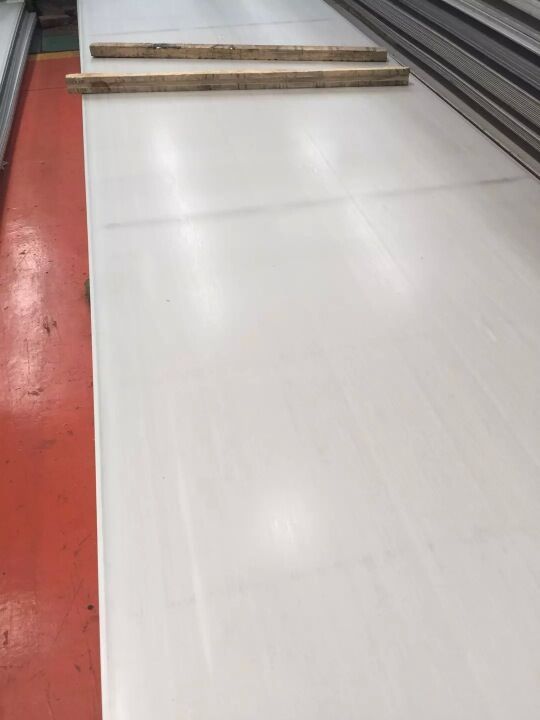
Stainless steel 446 is a high chromium ferritic heat resistant alloy with excellent resistance to oxidation, sulfidation and other forms of hot corrosion. This grade is most commonly used between 1500 - 2100 F degree, although its elevated temperature strength is quite low. 446 is the only heat resistant alloy that will tolerate molten copper and brass. As with other high chromium ferritic stainless, 446 embrittles severely in the 700-1000 F degree temperature range (885 F degree embrittlement). 446 should not be used in this temperature range unless nearly complete loss of room temperature ductility may be tolerated. Sigma phase embrittlement occurs upon long time exposure in the 1000-1300 F degree range.
446 has a high ductile-to-brittle impact transition temperature. Therefore, successful forming and bending is aided by low forming speeds, edge preparation and preheating to 250-400 F degree. Annealing, when necessary should be performed at 1550-1650 F degree followed by rapid cool.
Welding may be accomplished by conventional methods. Preheating and postheating to 300-600 F degree is helpful. Austenitic weld fillers, such as AWS E310 or E312 are generally suggested to maximize weld deposit ductility.
Chemistry
|
|
Cr |
C |
N |
Mn |
Si |
P |
S |
Fe |
|
MIN |
23.0 |
- |
- |
- |
- |
- |
- |
- |
|
MAX |
27.0 |
0.15 |
0.25 |
1.5 |
1.0 |
0.04 |
0.03 |
Bal |
Specifications
ASTM A 240, ASTM A 276, ASTM A 276 Condition A, ASTM A 276 Condition S
EN 1.4763
UNS S44600
Werkstoff 1.4763
Inventory
446 Sheet
Thickness 0.5-10mm
Width 1000mm-1500mm
Length 2000mm-6000mm
Features
Oxidation resistance through 2000 F degree
Sulfidation resistance
Good thermal conductivity
Resistance to molten copper
Low strength
Applications
Neutral salt pot electrodes
Recuperators
Spouts for conveying molten copper alloys
Oil burner parts
Combustion chambers
Furnace and kiln linings
Stack dampers
Boiler baffles
Glass molds
Soot blowers